QuizPlays Daily
  1. Home
  2. Science & Nature Quizzes
  3. Science Quiz

Science Quiz

  • Classic
  • 10 questions
  • About 3 min
  • Up to 3 stars

This science quiz pulls from chemistry, biology, physics and astronomy, so you'll go from element symbols and chromosomes to the speed of light and the planets next door. Most questions cover what you learned in school, with a few to keep the experts honest. Every answer comes with a quick, fascinating explanation, and no lab coat or safety goggles are required.
Why science makes great trivia

Science is full of facts that sound simple but took centuries to pin down. Even the word scientist is fairly new. The English scholar William Whewell coined it in 1833, at a time when people who studied nature were usually called natural philosophers. Before then, chemistry, physics and biology often blurred together.

One of the best stories in science is the periodic table. When the Russian chemist Dmitri Mendeleev presented his version in 1869, he left gaps for elements nobody had found yet and predicted what they would be like. Gallium turned up in 1875 and germanium in 1886, both closely matching his forecasts. It's a great example of how a good pattern can reveal what's still missing.

Science questions reward reasoning as much as memory. If you're stuck, think about what makes physical sense: which answer fits the scale of the thing being described, and which one would break the laws you already know? Breaking words into their roots helps, since many scientific terms are built from Greek and Latin pieces that describe exactly what something does. Biology, chemistry, space and everyday physics all show up here, so a broad curiosity pays off more than deep knowledge of one field.

Science questions and answers

Show all 10 questions with answers (spoilers!)
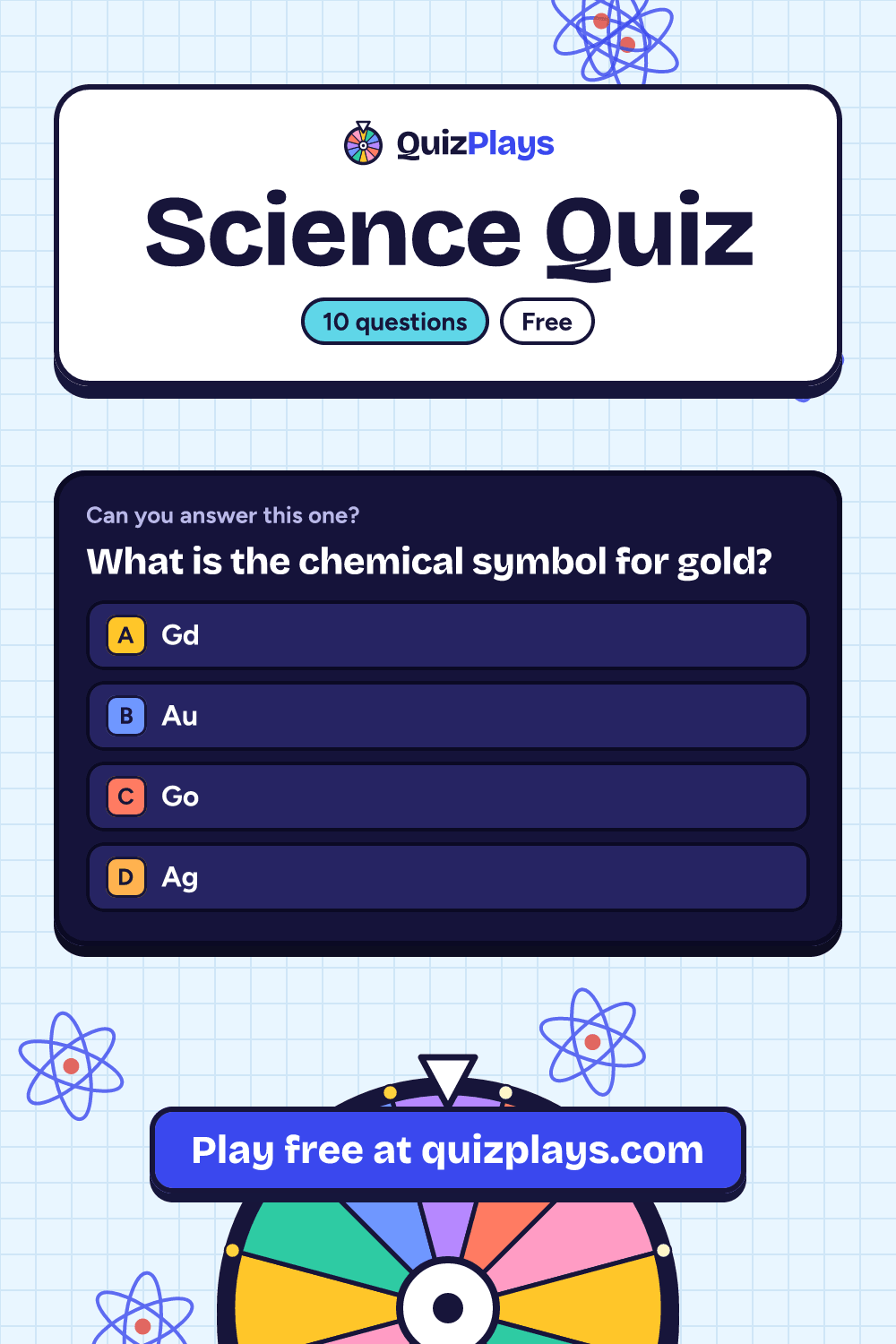
  1. What is the chemical symbol for gold?

    Answer: Au

    Au comes from aurum, the Latin word for gold.

  2. Which part of a cell is known as its powerhouse?

    Answer: Mitochondria

    Mitochondria turn food into usable energy called ATP.

  3. What is the most common gas in Earth's atmosphere?

    Answer: Nitrogen

    Nitrogen makes up about 78% of the air. Oxygen is about 21%.

  4. Which planet is known as the Red Planet?

    Answer: Mars

    Iron oxide, or rust, in its soil gives Mars its color.

  5. How many chromosomes do humans usually have?

    Answer: 46

    That's 23 pairs, one set from each parent.

  6. What is the lightest chemical element?

    Answer: Hydrogen

    Hydrogen is element number 1 and the most abundant in the universe.

  7. Which organ produces insulin?

    Answer: Pancreas

    Insulin helps move sugar from the blood into the body's cells.

  8. At sea level, water boils at what temperature?

    Answer: 212°F

    That's 100°C. Watch out: 100 is the Celsius figure, not Fahrenheit.

  9. Roughly how fast does light travel?

    Answer: 186,000 miles per second

    That's about 300,000 km per second. Sunlight takes about 8 minutes to reach Earth.

  10. What do bees collect from flowers to make honey?

    Answer: Nectar

    Bees also gather pollen, but it's nectar that becomes honey.

Spot a mistake? Tell us and we’ll fix it.

Science Quiz pin with a sample question

Save it for later

Pin this quiz to come back to it or share it with friends.

Save to Pinterest