QuizPlays Daily
  1. Home
  2. General Knowledge Quizzes
  3. Hard General Knowledge Quiz

Hard General Knowledge Quiz

  • Brain-buster
  • 10 questions
  • About 3 min
  • Up to 3 stars

Built to stump. Any score is bragging rights, and 9 or 10 earns the Genius title.

This hard general knowledge quiz is built for people who win bar trivia and want a real challenge. Expect tricky questions on chemistry, anatomy, art, opera, astronomy and European history, each one tough but fair. Every answer comes with a bonus fact, so even a wrong guess leaves you with something worth bragging about next time.
Where hard trivia comes from

The word trivia has a surprisingly old root. In Latin, a trivium was a spot where three roads met, a public crossroads where people swapped everyday news. Medieval schools later borrowed the word for the three basic arts of grammar, logic and rhetoric. The modern sense of trivia as small, curious facts took hold in the early 1900s, and trivia as a question-and-answer game caught on in the 1960s, the same decade Jeopardy! first aired on NBC in 1964.

A hard quiz is less about memorizing everything and more about reasoning well. When you don't know an answer outright, start by crossing off options that don't fit the time period or the field. Dates are great anchors: if you can place a question within a century, two or three choices often fall away. Details in the question itself, like a country or a year, are often your best clue.

Getting a tough one wrong is actually useful. Memory researchers call it the testing effect: actively pulling an answer out of your head, and then checking it, makes facts stick far better than rereading them. So guess boldly, read the bonus fact, and you'll likely remember it the next time it comes up.

Hard General Knowledge questions and answers

Show all 10 questions with answers (spoilers!)
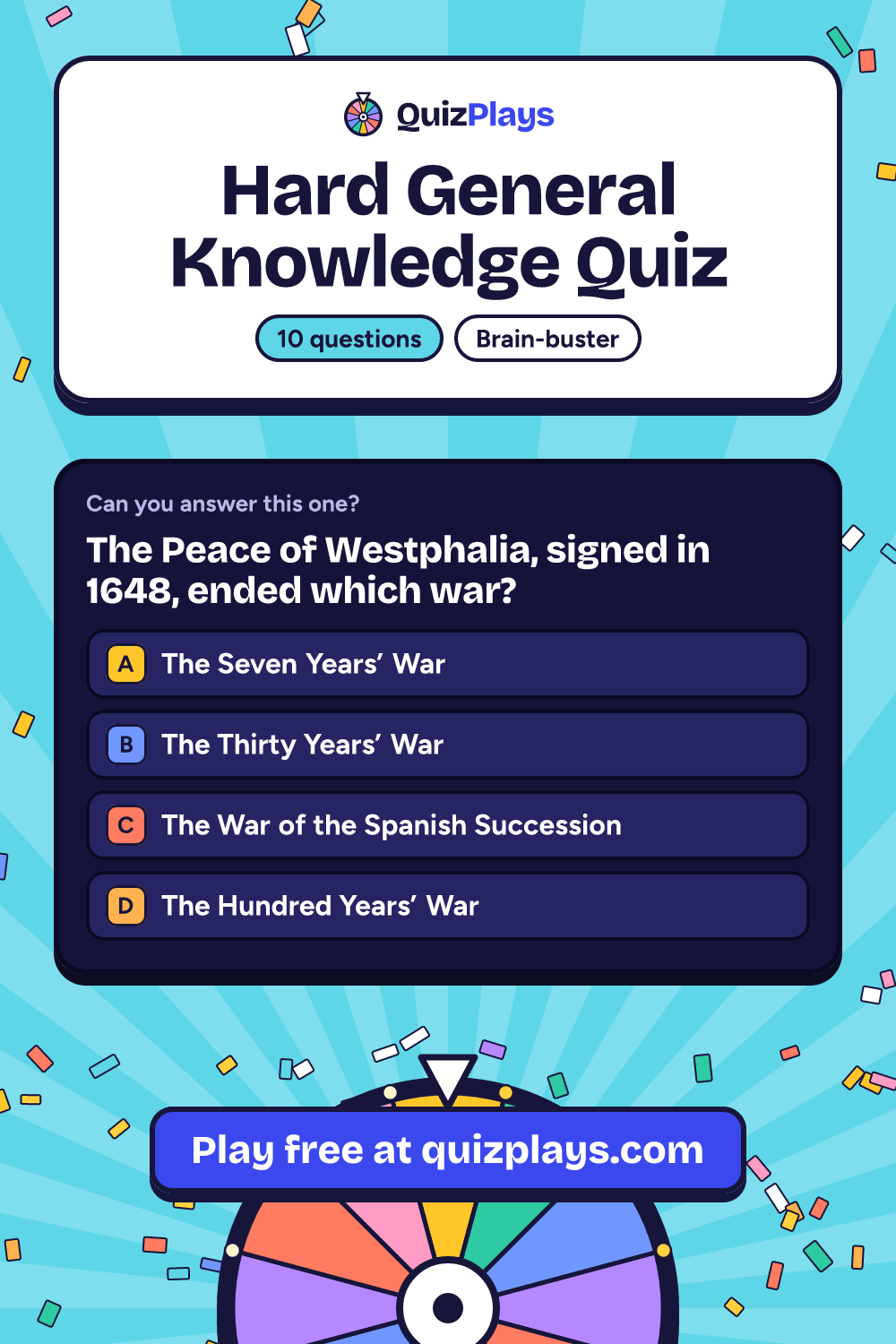
  1. The Peace of Westphalia, signed in 1648, ended which war?

    Answer: The Thirty Years' War

    The treaties were signed in two Westphalian cities, Osnabrück and Münster.

  2. Which element has the chemical symbol W?

    Answer: Tungsten

    W comes from 'wolfram', and tungsten has the highest melting point of any metal: 6,192°F (3,422°C).

  3. Which is the only bone in the human body not connected to any other bone?

    Answer: Hyoid

    The horseshoe-shaped hyoid sits in your neck, held in place by muscles and ligaments.

  4. Who painted the triptych The Garden of Earthly Delights?

    Answer: Hieronymus Bosch

    The surreal masterpiece has hung in Madrid's Prado Museum since 1939.

  5. Which Swedish village gave its name to four chemical elements?

    Answer: Ytterby

    Yttrium, terbium, erbium and ytterbium were all named after minerals from its quarry.

  6. Which element is the most electronegative on the Pauling scale?

    Answer: Fluorine

    Fluorine scores 3.98, making it the greediest element of all for electrons.

  7. Which is the only planet in our Solar System less dense than water?

    Answer: Saturn

    Saturn is about 30% less dense than water, mostly thanks to its hydrogen and helium.

  8. In which city did Mozart's opera The Magic Flute premiere in 1791?

    Answer: Vienna

    It opened on September 30, 1791, just over two months before Mozart died.

  9. Which city hosted the 1988 Summer Olympics?

    Answer: Seoul

    Seoul's Games ran from September 17 to October 2, 1988, making South Korea the second Asian host.

  10. Whose inactivated polio vaccine was announced as a success in 1955?

    Answer: Jonas Salk

    Salk's vaccine used killed virus; Albert Sabin's later oral vaccine used a weakened live one.

Spot a mistake? Tell us and we’ll fix it.

Hard General Knowledge Quiz pin with a sample question

Save it for later

Pin this quiz to come back to it or share it with friends.

Save to Pinterest