QuizPlays Daily
  1. Home
  2. Bar Trivia Questions
  3. Science Trivia Questions

Science Trivia Questions

  • Classic
  • 10 questions
  • About 3 min
  • Up to 3 stars

These science trivia questions make a lively bar trivia round, hopping from chemistry and physics to the human body, wildlife and the scientists behind famous breakthroughs. Play on your own for bragging rights, or read them out as pub quiz questions at your own trivia night, since each answer comes with a quick fact the quizmaster can share before scores are tallied.

Hosting a trivia night? Get the printable round with answer key
Why science makes a great trivia round

Science questions are a trivia host's best friend because the answers do not drift with the news. A chemical symbol, a unit of measurement or the name of a famous experiment stays the same year after year, so a well-written science round can be used again and again. It also rewards a different kind of player than pop culture rounds do, which keeps the scoreboard close.

A good way to approach a science round is to sort each question by field before you answer. Ask yourself whether it belongs to chemistry, physics, biology or earth science, then think about what a high school class in that subject would have covered. Many famous discoveries also came in clusters, with the 1800s bringing a burst of work on electricity and the early 1900s transforming medicine, so placing a question in its era can narrow your choices quickly.

When you play, think about everyday experience too. Plenty of classic questions connect to things you have seen in a kitchen, a doctor's office or a high school lab, so picture the real object before you guess. And if you are hosting, a quick fact after each answer turns a dry formula into a story people remember on the drive home.

Science Trivia questions and answers

Show all 10 questions with answers (spoilers!)
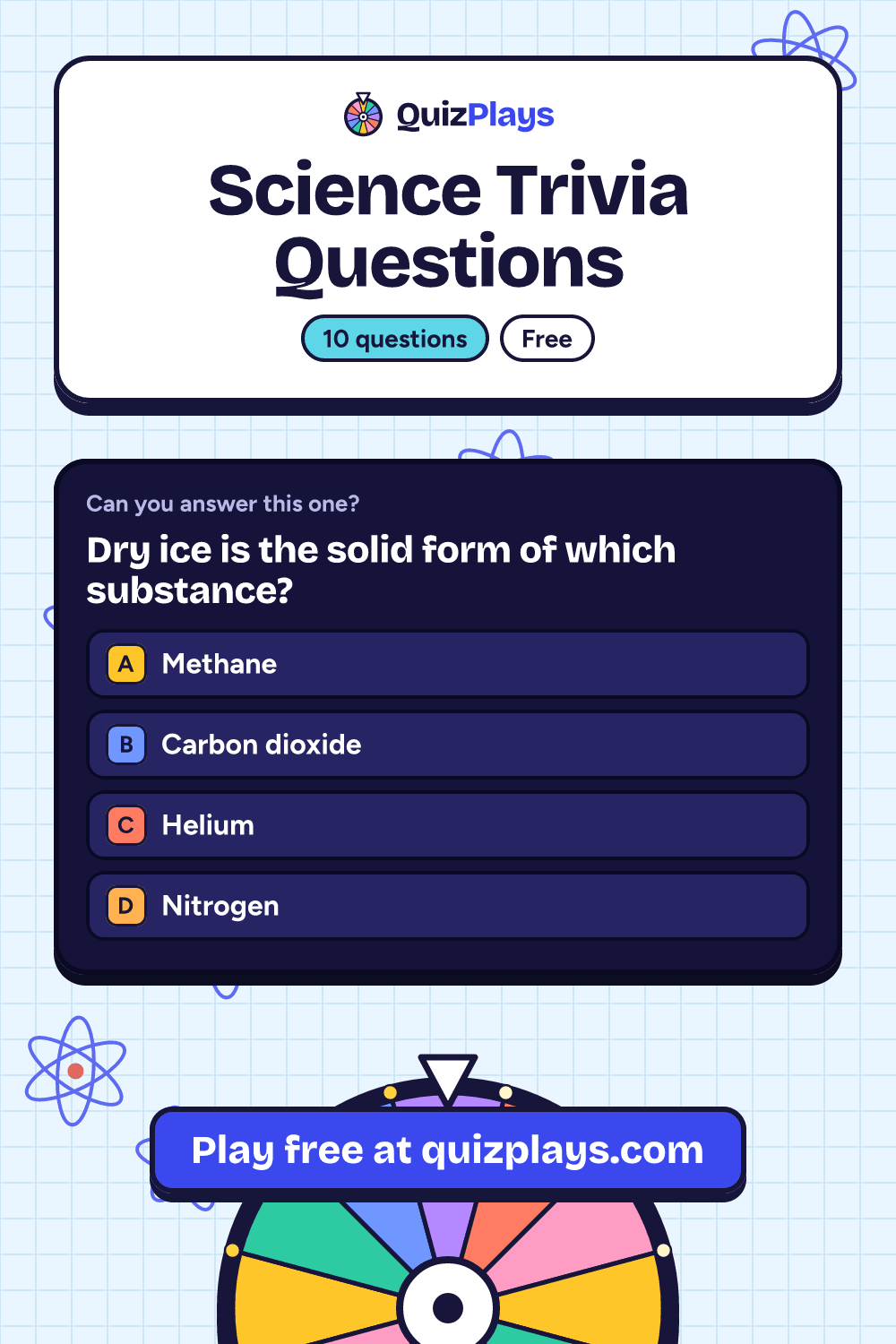
  1. Dry ice is the solid form of which substance?

    Answer: Carbon dioxide

    It skips the liquid stage entirely, turning straight into gas at about −109°F (−78.5°C).

  2. Your skin makes which vitamin when it is exposed to sunlight?

    Answer: Vitamin D

    Ultraviolet B rays kick off its production, and the vitamin helps your body absorb calcium for strong bones.

  3. Who discovered penicillin in 1928?

    Answer: Alexander Fleming

    He noticed a stray mold killing bacteria on a culture plate left out at St. Mary's Hospital in London.

  4. What color does blue litmus paper turn when it is dipped in an acid?

    Answer: Red

    Litmus dye comes from lichens, and red litmus paper turns blue in a base.

  5. What is the chemical symbol for sodium?

    Answer: Na

    Na comes from natrium, its Latin name; Sn is the symbol for tin and S is sulfur.

  6. Which unit is used to measure frequency, in cycles per second?

    Answer: Hertz

    It honors German physicist Heinrich Hertz, who proved that radio waves exist in the late 1880s.

  7. What does DNA stand for?

    Answer: Deoxyribonucleic acid

    In 1953 James Watson and Francis Crick described its double helix, drawing on X-ray work by Rosalind Franklin.

  8. Which animals are the only mammals capable of true, sustained flight?

    Answer: Bats

    Flying squirrels, sugar gliders and colugos can only glide, using flaps of skin stretched between their limbs.

  9. What is the scientific study of fungi called?

    Answer: Mycology

    Surprisingly, fungi are more closely related to animals than to plants.

  10. Marie Curie named which element after her native country?

    Answer: Polonium

    In 1898 Poland was split among neighboring empires, and she hoped the name would draw attention to its cause.

Spot a mistake? Tell us and we’ll fix it.

Science Trivia Questions pin with a sample question

Save it for later

Pin this quiz to come back to it or share it with friends.

Save to Pinterest